Fiches de son
Fiche de son de Pablonite.
Titre 1 sur 7 de Soul Spam · 22:13
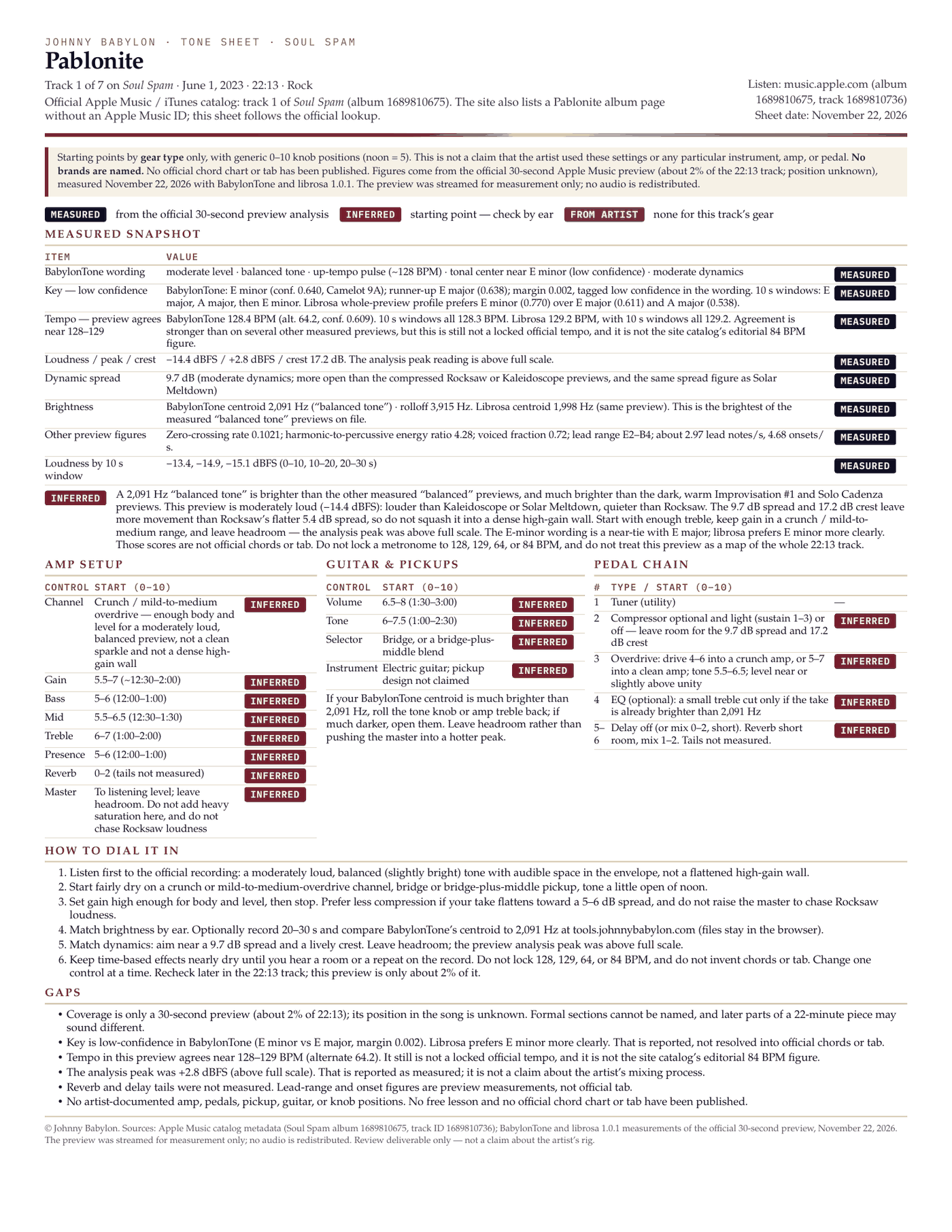
Official Apple Music / iTunes catalog: track 1 of Soul Spam (album 1689810675). The site also lists a Pablonite album page without an Apple Music ID; this sheet follows the official lookup.
Points de départ pour l’ampli, la guitare, les micros et les pédales, indiqués comme mesurés ou déduits à partir de l’extrait officiel de 30 secondes. Vérifiez-les à l’oreille avec l’enregistrement.
Starting points by gear type only, with generic 0–10 knob positions (noon = 5). This is not a claim that the artist used these settings or any particular instrument, amp, or pedal. No brands are named. No official chord chart or tab has been published. Figures come from the official 30-second Apple Music preview (about 2% of the 22:13 track; position unknown), measured November 22, 2026 with BabylonTone and librosa 1.0.1. The official catalog places this track on Soul Spam. The preview was streamed for measurement only; no audio is redistributed.
Les détails des réglages de cette fiche de son sont en anglais jusqu'à ce qu'une traduction native soit prête.
- MesuréIssu de l'analyse de l'extrait
- DéduitUn point de départ ou une interprétation pédagogique — à vérifier à l'oreille
- De l'artisteAucun pour le matériel de ce morceau
Télécharger le PDF d'une pageÉcouter sur Apple MusicToutes les fiches de son
Instantané mesuré
| Élément | Valeur | Libellé |
|---|---|---|
| BabylonTone wording | moderate level · balanced tone · up-tempo pulse (~128 BPM) · tonal center near E minor (low confidence) · moderate dynamics | Mesuré |
| Key — low confidence | BabylonTone: E minor (conf. 0.640, Camelot 9A); runner-up E major (0.638); margin 0.002, tagged low confidence in the wording. 10 s windows: E major, A major, then E minor. Librosa whole-preview profile prefers E minor (0.770) over E major (0.611) and A major (0.538). | Mesuré |
| Tempo — preview agrees near 128–129 | BabylonTone 128.4 BPM (alt. 64.2, conf. 0.609). 10 s windows all 128.3 BPM. Librosa 129.2 BPM, with 10 s windows all 129.2. Agreement is stronger than on several other measured previews, but this is still not a locked official tempo, and it is not the site catalog’s editorial 84 BPM figure. | Mesuré |
| Loudness / peak / crest | −14.4 dBFS / +2.8 dBFS / crest 17.2 dB. The analysis peak reading is above full scale. | Mesuré |
| Dynamic spread | 9.7 dB (moderate dynamics; more open than the compressed Rocksaw or Kaleidoscope previews, and the same spread figure as Solar Meltdown) | Mesuré |
| Brightness | BabylonTone centroid 2,091 Hz (“balanced tone”) · rolloff 3,915 Hz. Librosa centroid 1,998 Hz (same preview). This is the brightest of the measured “balanced tone” previews on file. | Mesuré |
| Other preview figures | Zero-crossing rate 0.1021; harmonic-to-percussive energy ratio 4.28; voiced fraction 0.72; lead range E2–B4; about 2.97 lead notes/s, 4.68 onsets/s. | Mesuré |
| Loudness by 10 s window | −13.4, −14.9, −15.1 dBFS (0–10, 10–20, 20–30 s) | Mesuré |
Déduit A 2,091 Hz “balanced tone” is brighter than the other measured “balanced” previews, and much brighter than the dark, warm Improvisation #1 and Solo Cadenza previews. This preview is moderately loud (−14.4 dBFS): louder than Kaleidoscope or Solar Meltdown, quieter than Rocksaw. The 9.7 dB spread and 17.2 dB crest leave more movement than Rocksaw’s flatter 5.4 dB spread, so do not squash it into a dense high-gain wall. Start with enough treble, keep gain in a crunch / mild-to-medium range, and leave headroom — the analysis peak was above full scale. The E-minor wording is a near-tie with E major; librosa prefers E minor more clearly. Those scores are not official chords or tab. Do not lock a metronome to 128, 129, 64, or 84 BPM, and do not treat this preview as a map of the whole 22:13 track.
Réglage de l'ampli
| Contrôle | Point de départ (0–10) | Libellé |
|---|---|---|
| Channel | Crunch / mild-to-medium overdrive — enough body and level for a moderately loud, balanced preview, not a clean sparkle and not a dense high-gain wall | Déduit |
| Gain | 5.5–7 (~12:30–2:00) | Déduit |
| Bass | 5–6 (12:00–1:00) | Déduit |
| Mid | 5.5–6.5 (12:30–1:30) | Déduit |
| Treble | 6–7 (1:00–2:00) | Déduit |
| Presence | 5–6 (12:00–1:00) | Déduit |
| Reverb | 0–2 (tails not measured) | Déduit |
| Master | To listening level; leave headroom. Do not add heavy saturation here, and do not chase Rocksaw loudness | Déduit |
Guitare et micros
| Contrôle | Point de départ (0–10) | Libellé |
|---|---|---|
| Volume | 6.5–8 (1:30–3:00) | Déduit |
| Tone | 6–7.5 (1:00–2:30) | Déduit |
| Selector | Bridge, or a bridge-plus-middle blend | Déduit |
| Instrument | Electric guitar; pickup design not claimed | Déduit |
If your BabylonTone centroid is much brighter than 2,091 Hz, roll the tone knob or amp treble back; if much darker, open them. Leave headroom rather than pushing the master into a hotter peak.
Chaîne de pédales
| Ordre | Type et point de départ (0–10) | Libellé |
|---|---|---|
| 1 | Tuner (utility) | — |
| 2 | Compressor optional and light (sustain 1–3) or off — leave room for the 9.7 dB spread and 17.2 dB crest | Déduit |
| 3 | Overdrive: drive 4–6 into a crunch amp, or 5–7 into a clean amp; tone 5.5–6.5; level near or slightly above unity | Déduit |
| 4 | EQ (optional): a small treble cut only if the take is already brighter than 2,091 Hz | Déduit |
| 5–6 | Delay off (or mix 0–2, short). Reverb short room, mix 1–2. Tails not measured. | Déduit |
Comment le régler
- Listen first to the official recording: a moderately loud, balanced (slightly bright) tone with audible space in the envelope, not a flattened high-gain wall.
- Start fairly dry on a crunch or mild-to-medium-overdrive channel, bridge or bridge-plus-middle pickup, tone a little open of noon.
- Set gain high enough for body and level, then stop. Prefer less compression if your take flattens toward a 5–6 dB spread, and do not raise the master to chase Rocksaw loudness.
- Match brightness by ear. Optionally record 20–30 s and compare BabylonTone’s centroid to 2,091 Hz at tools.johnnybabylon.com (files stay in the browser).
- Match dynamics: aim near a 9.7 dB spread and a lively crest. Leave headroom; the preview analysis peak was above full scale.
- Keep time-based effects nearly dry until you hear a room or a repeat on the record. Do not lock 128, 129, 64, or 84 BPM, and do not invent chords or tab. Change one control at a time. Recheck later in the 22:13 track; this preview is only about 2% of it.
Lacunes
- Coverage is only a 30-second preview (about 2% of 22:13); its position in the song is unknown. Formal sections cannot be named, and later parts of a 22-minute piece may sound different.
- Key is low-confidence in BabylonTone (E minor vs E major, margin 0.002). Librosa prefers E minor more clearly. That is reported, not resolved into official chords or tab.
- Tempo in this preview agrees near 128–129 BPM (alternate 64.2). It still is not a locked official tempo, and it is not the site catalog’s editorial 84 BPM figure.
- The analysis peak was +2.8 dBFS (above full scale). That is reported as measured; it is not a claim about the artist’s mixing process.
- Reverb and delay tails were not measured. Lead-range and onset figures are preview measurements, not official tab.
- No artist-documented amp, pedals, pickup, guitar, or knob positions. No free lesson and no official chord chart or tab have been published.