Free guitar lesson
Solo Cadenza: lead phrasing and cadenza structure
A free, self-paced lesson on lead phrasing and the structure of Solo Cadenza, the closer on Bro by Bro. Notes marked measured come from the preview analysis. Notes marked inferred are teaching interpretations to check by ear. Non-English text in the lesson is flagged as needing native review. The lesson runs here on its own. In an LMS, the same package can record the quiz.
Download SCORM 1.2 packageDas Tonblatt öffnen
Tonblatt
Klangblatt zu Solo Cadenza
Eine einseitige Übersicht gemessener Vorschauzahlen und abgeleiteter Ausgangspunkte für Verstärker, Gitarre, Tonabnehmer und Pedale. Die Einstellungen sind Ausgangspunkte, nicht das Equipment des Künstlers.
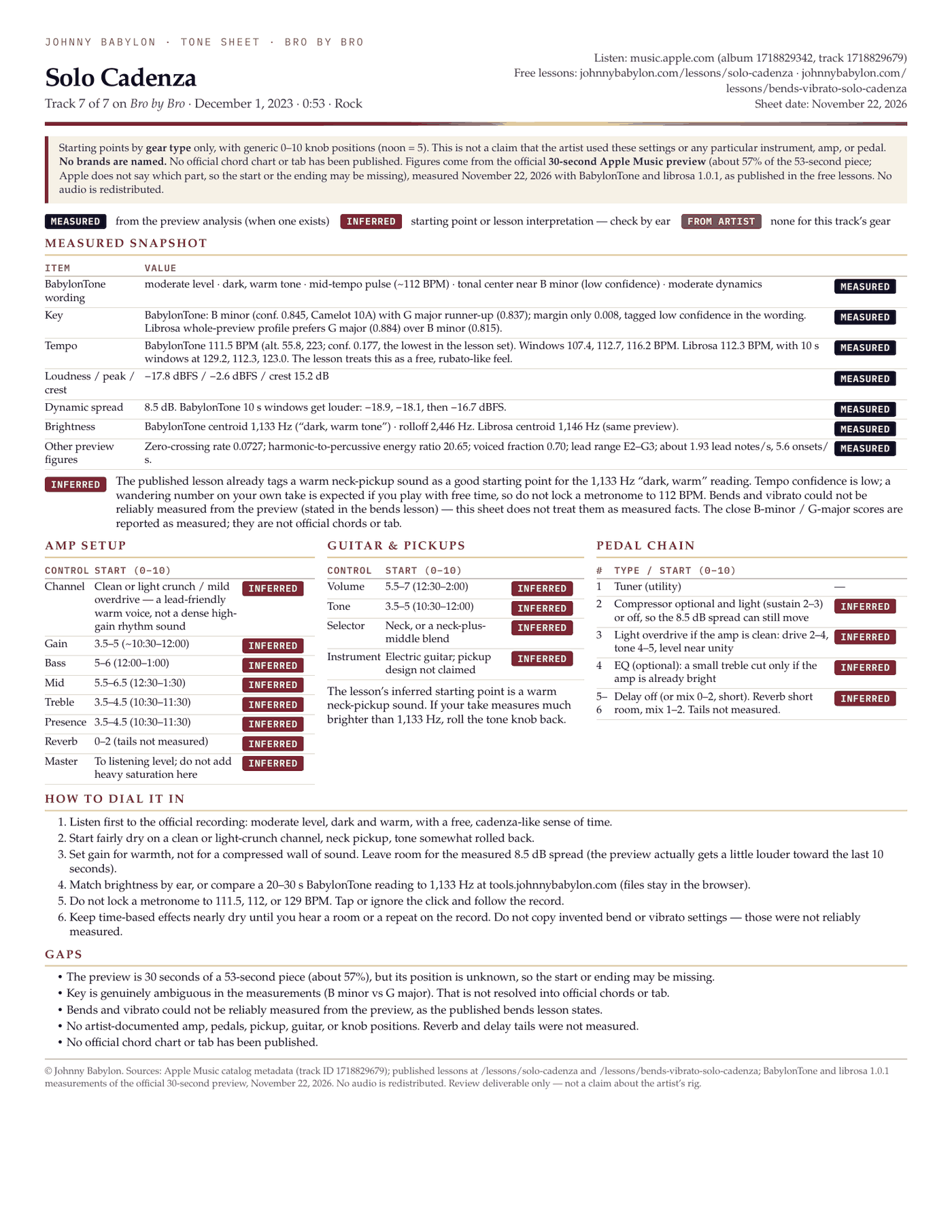
Starting points by gear type only, with generic 0–10 knob positions (noon = 5). This is not a claim that the artist used these settings or any particular instrument, amp, or pedal. No brands are named. No official chord chart or tab has been published. Figures come from the official 30-second Apple Music preview (about 57% of the 53-second piece; Apple does not say which part, so the start or the ending may be missing), measured November 22, 2026 with BabylonTone and librosa 1.0.1, as published in the free lessons. No audio is redistributed.
Die Einstellungsdetails auf diesem Tonblatt stehen auf Englisch, bis eine muttersprachliche Übersetzung vorliegt.
- GemessenAus der Analyse der Vorschau
- AbgeleitetEin Ausgangspunkt oder eine didaktische Deutung — nach Gehör prüfen
- Vom KünstlerKeine Angaben zum Equipment dieses Titels
Einseitiges PDF herunterladenAuf Apple Music anhörenDas vollständige Klangblatt öffnen
Gemessene Momentaufnahme
| Punkt | Wert | Kennzeichnung |
|---|---|---|
| BabylonTone wording | moderate level · dark, warm tone · mid-tempo pulse (~112 BPM) · tonal center near B minor (low confidence) · moderate dynamics | Gemessen |
| Key | BabylonTone: B minor (conf. 0.845, Camelot 10A) with G major runner-up (0.837); margin only 0.008, tagged low confidence in the wording. Librosa whole-preview profile prefers G major (0.884) over B minor (0.815). | Gemessen |
| Tempo | BabylonTone 111.5 BPM (alt. 55.8, 223; conf. 0.177, the lowest in the lesson set). Windows 107.4, 112.7, 116.2 BPM. Librosa 112.3 BPM, with 10 s windows at 129.2, 112.3, 123.0. The lesson treats this as a free, rubato-like feel. | Gemessen |
| Loudness / peak / crest | −17.8 dBFS / −2.6 dBFS / crest 15.2 dB | Gemessen |
| Dynamic spread | 8.5 dB. BabylonTone 10 s windows get louder: −18.9, −18.1, then −16.7 dBFS. | Gemessen |
| Brightness | BabylonTone centroid 1,133 Hz (“dark, warm tone”) · rolloff 2,446 Hz. Librosa centroid 1,146 Hz (same preview). | Gemessen |
| Other preview figures | Zero-crossing rate 0.0727; harmonic-to-percussive energy ratio 20.65; voiced fraction 0.70; lead range E2–G3; about 1.93 lead notes/s, 5.6 onsets/s. | Gemessen |
Abgeleitet The published lesson already tags a warm neck-pickup sound as a good starting point for the 1,133 Hz “dark, warm” reading. Tempo confidence is low; a wandering number on your own take is expected if you play with free time, so do not lock a metronome to 112 BPM. Bends and vibrato could not be reliably measured from the preview (stated in the bends lesson) — this sheet does not treat them as measured facts. The close B-minor / G-major scores are reported as measured; they are not official chords or tab.
Verstärkereinstellung
| Regler | Ausgangspunkt (0–10) | Kennzeichnung |
|---|---|---|
| Channel | Clean or light crunch / mild overdrive — a lead-friendly warm voice, not a dense high-gain rhythm sound | Abgeleitet |
| Gain | 3.5–5 (~10:30–12:00) | Abgeleitet |
| Bass | 5–6 (12:00–1:00) | Abgeleitet |
| Mid | 5.5–6.5 (12:30–1:30) | Abgeleitet |
| Treble | 3.5–4.5 (10:30–11:30) | Abgeleitet |
| Presence | 3.5–4.5 (10:30–11:30) | Abgeleitet |
| Reverb | 0–2 (tails not measured) | Abgeleitet |
| Master | To listening level; do not add heavy saturation here | Abgeleitet |
Gitarre und Tonabnehmer
| Regler | Ausgangspunkt (0–10) | Kennzeichnung |
|---|---|---|
| Volume | 5.5–7 (12:30–2:00) | Abgeleitet |
| Tone | 3.5–5 (10:30–12:00) | Abgeleitet |
| Selector | Neck, or a neck-plus-middle blend | Abgeleitet |
| Instrument | Electric guitar; pickup design not claimed | Abgeleitet |
The lesson’s inferred starting point is a warm neck-pickup sound. If your take measures much brighter than 1,133 Hz, roll the tone knob back.
Pedalkette
| Reihenfolge | Typ und Ausgangspunkt (0–10) | Kennzeichnung |
|---|---|---|
| 1 | Tuner (utility) | — |
| 2 | Compressor optional and light (sustain 2–3) or off, so the 8.5 dB spread can still move | Abgeleitet |
| 3 | Light overdrive if the amp is clean: drive 2–4, tone 4–5, level near unity | Abgeleitet |
| 4 | EQ (optional): a small treble cut only if the amp is already bright | Abgeleitet |
| 5–6 | Delay off (or mix 0–2, short). Reverb short room, mix 1–2. Tails not measured. | Abgeleitet |
So stellen Sie es ein
- Listen first to the official recording: moderate level, dark and warm, with a free, cadenza-like sense of time.
- Start fairly dry on a clean or light-crunch channel, neck pickup, tone somewhat rolled back.
- Set gain for warmth, not for a compressed wall of sound. Leave room for the measured 8.5 dB spread (the preview actually gets a little louder toward the last 10 seconds).
- Match brightness by ear, or compare a 20–30 s BabylonTone reading to 1,133 Hz at tools.johnnybabylon.com (files stay in the browser).
- Do not lock a metronome to 111.5, 112, or 129 BPM. Tap or ignore the click and follow the record.
- Keep time-based effects nearly dry until you hear a room or a repeat on the record. Do not copy invented bend or vibrato settings — those were not reliably measured.
Lücken
- The preview is 30 seconds of a 53-second piece (about 57%), but its position is unknown, so the start or ending may be missing.
- Key is genuinely ambiguous in the measurements (B minor vs G major). That is not resolved into official chords or tab.
- Bends and vibrato could not be reliably measured from the preview, as the published bends lesson states.
- No artist-documented amp, pedals, pickup, guitar, or knob positions. Reverb and delay tails were not measured.
- No official chord chart or tab has been published.