Free guitar lesson
Improvising in E minor: Guitar Ecstasy Improvisastion #1
A free, self-paced lesson on improvising in E minor from Guitar Ecstasy Improvisastion #1. Notes marked measured come from the preview analysis. Notes marked inferred are teaching interpretations to check by ear. Non-English text in the lesson is flagged as needing native review. The lesson runs here on its own. In an LMS, the same package can record the quiz.
Download SCORM 1.2 packageHet toonblad openen
Toonblad
Toonblad voor Guitar Ecstasy Improvisastion #1 in E Minor
Een overzicht van één pagina met gemeten previewcijfers en afgeleide startpunten voor versterker, gitaar, elementen en pedalen. De instellingen zijn startpunten, niet de uitrusting van de artiest.
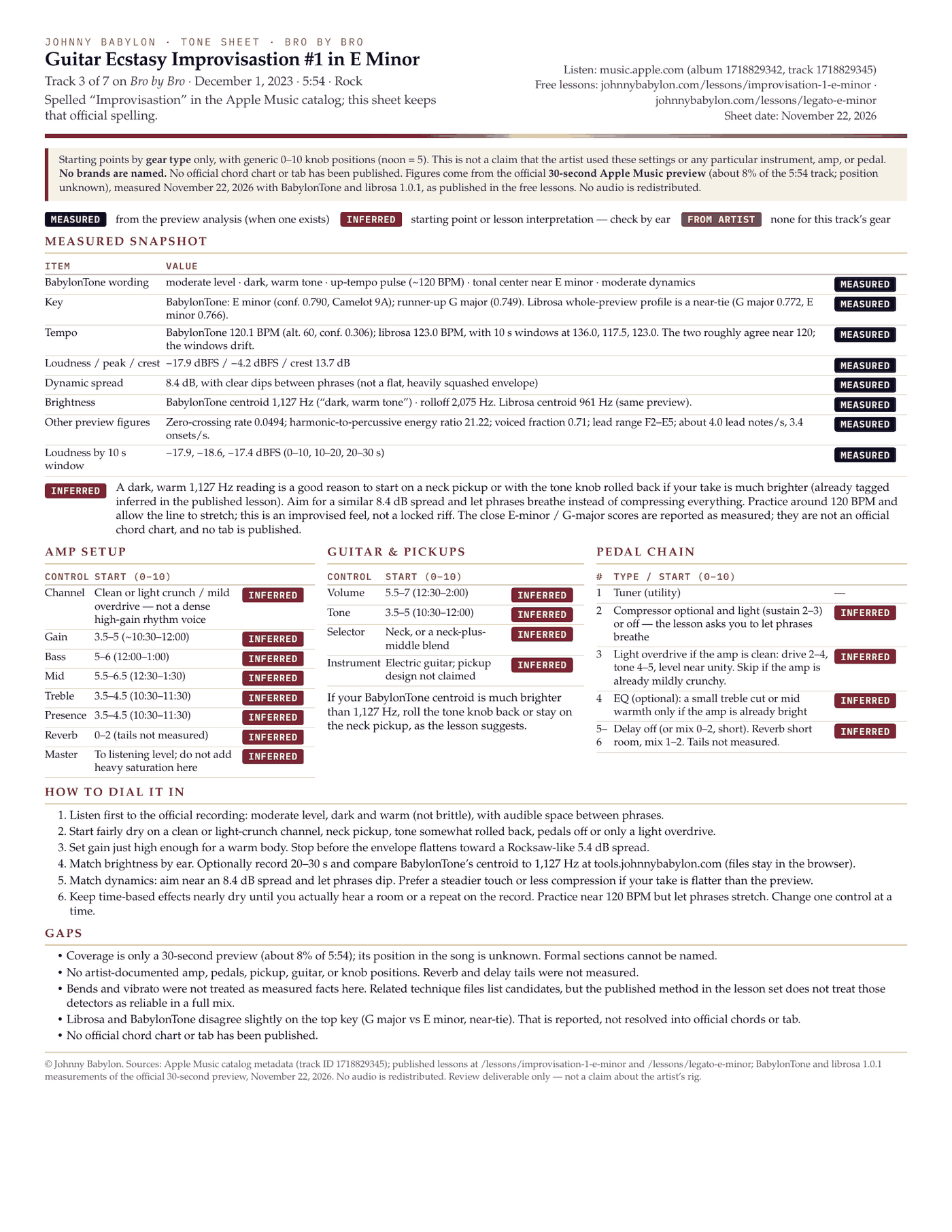
Starting points by gear type only, with generic 0–10 knob positions (noon = 5). This is not a claim that the artist used these settings or any particular instrument, amp, or pedal. No brands are named. No official chord chart or tab has been published. Figures come from the official 30-second Apple Music preview (about 8% of the 5:54 track; position unknown), measured November 22, 2026 with BabylonTone and librosa 1.0.1, as published in the free lessons. No audio is redistributed.
De instellingsdetails op dit toonblad staan in het Engels totdat er een native vertaling klaar is.
- GemetenUit de analyse van de preview
- AfgeleidEen startpunt of een didactische uitleg — controleer op gehoor
- Van de artiestGeen voor de apparatuur van dit nummer
Pdf van één pagina downloadenLuisteren op Apple MusicHet volledige toonblad openen
Gemeten momentopname
| Onderdeel | Waarde | Label |
|---|---|---|
| BabylonTone wording | moderate level · dark, warm tone · up-tempo pulse (~120 BPM) · tonal center near E minor · moderate dynamics | Gemeten |
| Key | BabylonTone: E minor (conf. 0.790, Camelot 9A); runner-up G major (0.749). Librosa whole-preview profile is a near-tie (G major 0.772, E minor 0.766). | Gemeten |
| Tempo | BabylonTone 120.1 BPM (alt. 60, conf. 0.306); librosa 123.0 BPM, with 10 s windows at 136.0, 117.5, 123.0. The two roughly agree near 120; the windows drift. | Gemeten |
| Loudness / peak / crest | −17.9 dBFS / −4.2 dBFS / crest 13.7 dB | Gemeten |
| Dynamic spread | 8.4 dB, with clear dips between phrases (not a flat, heavily squashed envelope) | Gemeten |
| Brightness | BabylonTone centroid 1,127 Hz (“dark, warm tone”) · rolloff 2,075 Hz. Librosa centroid 961 Hz (same preview). | Gemeten |
| Other preview figures | Zero-crossing rate 0.0494; harmonic-to-percussive energy ratio 21.22; voiced fraction 0.71; lead range F2–E5; about 4.0 lead notes/s, 3.4 onsets/s. | Gemeten |
| Loudness by 10 s window | −17.9, −18.6, −17.4 dBFS (0–10, 10–20, 20–30 s) | Gemeten |
Afgeleid A dark, warm 1,127 Hz reading is a good reason to start on a neck pickup or with the tone knob rolled back if your take is much brighter (already tagged inferred in the published lesson). Aim for a similar 8.4 dB spread and let phrases breathe instead of compressing everything. Practice around 120 BPM and allow the line to stretch; this is an improvised feel, not a locked riff. The close E-minor / G-major scores are reported as measured; they are not an official chord chart, and no tab is published.
Versterkerinstelling
| Regelaar | Startpunt (0–10) | Label |
|---|---|---|
| Channel | Clean or light crunch / mild overdrive — not a dense high-gain rhythm voice | Afgeleid |
| Gain | 3.5–5 (~10:30–12:00) | Afgeleid |
| Bass | 5–6 (12:00–1:00) | Afgeleid |
| Mid | 5.5–6.5 (12:30–1:30) | Afgeleid |
| Treble | 3.5–4.5 (10:30–11:30) | Afgeleid |
| Presence | 3.5–4.5 (10:30–11:30) | Afgeleid |
| Reverb | 0–2 (tails not measured) | Afgeleid |
| Master | To listening level; do not add heavy saturation here | Afgeleid |
Gitaar en elementen
| Regelaar | Startpunt (0–10) | Label |
|---|---|---|
| Volume | 5.5–7 (12:30–2:00) | Afgeleid |
| Tone | 3.5–5 (10:30–12:00) | Afgeleid |
| Selector | Neck, or a neck-plus-middle blend | Afgeleid |
| Instrument | Electric guitar; pickup design not claimed | Afgeleid |
If your BabylonTone centroid is much brighter than 1,127 Hz, roll the tone knob back or stay on the neck pickup, as the lesson suggests.
Pedaalketen
| Volgorde | Type en startpunt (0–10) | Label |
|---|---|---|
| 1 | Tuner (utility) | — |
| 2 | Compressor optional and light (sustain 2–3) or off — the lesson asks you to let phrases breathe | Afgeleid |
| 3 | Light overdrive if the amp is clean: drive 2–4, tone 4–5, level near unity. Skip if the amp is already mildly crunchy. | Afgeleid |
| 4 | EQ (optional): a small treble cut or mid warmth only if the amp is already bright | Afgeleid |
| 5–6 | Delay off (or mix 0–2, short). Reverb short room, mix 1–2. Tails not measured. | Afgeleid |
Zo stel je het in
- Listen first to the official recording: moderate level, dark and warm (not brittle), with audible space between phrases.
- Start fairly dry on a clean or light-crunch channel, neck pickup, tone somewhat rolled back, pedals off or only a light overdrive.
- Set gain just high enough for a warm body. Stop before the envelope flattens toward a Rocksaw-like 5.4 dB spread.
- Match brightness by ear. Optionally record 20–30 s and compare BabylonTone’s centroid to 1,127 Hz at tools.johnnybabylon.com (files stay in the browser).
- Match dynamics: aim near an 8.4 dB spread and let phrases dip. Prefer a steadier touch or less compression if your take is flatter than the preview.
- Keep time-based effects nearly dry until you actually hear a room or a repeat on the record. Practice near 120 BPM but let phrases stretch. Change one control at a time.
Hiaten
- Coverage is only a 30-second preview (about 8% of 5:54); its position in the song is unknown. Formal sections cannot be named.
- No artist-documented amp, pedals, pickup, guitar, or knob positions. Reverb and delay tails were not measured.
- Bends and vibrato were not treated as measured facts here. Related technique files list candidates, but the published method in the lesson set does not treat those detectors as reliable in a full mix.
- Librosa and BabylonTone disagree slightly on the top key (G major vs E minor, near-tie). That is reported, not resolved into official chords or tab.
- No official chord chart or tab has been published.