Tonblatt
Rocksaw-Tonblatt.
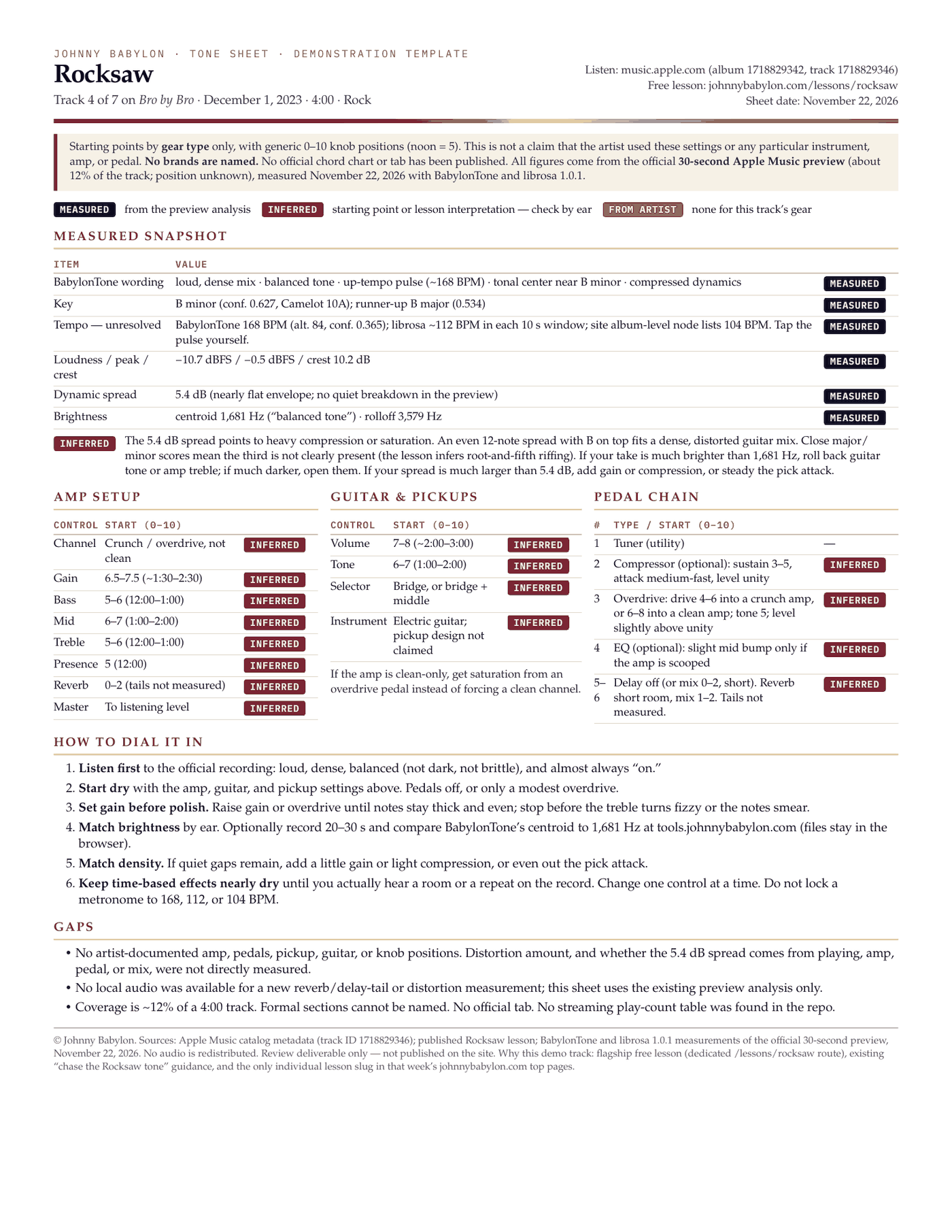
Ausgangspunkte für Verstärker, Gitarre, Tonabnehmer und Pedale, als gemessen oder abgeleitet aus der offiziellen 30-Sekunden-Vorschau gekennzeichnet. Prüfen Sie sie nach Gehör an der Aufnahme.
Diese Einstellungen sind Ausgangspunkte nach Geräteart, mit allgemeinen Positionen von 0 bis 10 (12 Uhr ist 5). Damit wird nicht behauptet, der Künstler habe diese Einstellungen oder ein bestimmtes Instrument, einen bestimmten Verstärker oder ein bestimmtes Pedal verwendet. Es wurde kein offizielles Akkordblatt und keine offizielle Tabulatur veröffentlicht. Die Zahlen stammen aus der offiziellen 30-Sekunden-Vorschau (etwa 12 % des Titels; die Stelle im Stück ist unbekannt).
Die Einstellungsdetails auf diesem Tonblatt stehen auf Englisch, bis eine muttersprachliche Übersetzung vorliegt.
- GemessenAus der Analyse der Vorschau
- AbgeleitetEin Ausgangspunkt oder eine didaktische Deutung — nach Gehör prüfen
- Vom KünstlerKeine Angaben zum Equipment dieses Titels
Einseitiges PDF herunterladenZurück zur Rocksaw-Lektion
Gemessene Momentaufnahme
| Punkt | Wert | Kennzeichnung |
|---|---|---|
| BabylonTone wording | loud, dense mix · balanced tone · up-tempo pulse (~168 BPM) · tonal center near B minor · compressed dynamics | Gemessen |
| Key | B minor (conf. 0.627, Camelot 10A); runner-up B major (0.534) | Gemessen |
| Tempo — unresolved | BabylonTone 168 BPM (alt. 84, conf. 0.365); librosa ~112 BPM in each 10 s window; site album-level node lists 104 BPM. Tap the pulse yourself. | Gemessen |
| Loudness / peak / crest | −10.7 dBFS / −0.5 dBFS / crest 10.2 dB | Gemessen |
| Dynamic spread | 5.4 dB (nearly flat envelope; no quiet breakdown in the preview) | Gemessen |
| Brightness | centroid 1,681 Hz (“balanced tone”) · rolloff 3,579 Hz | Gemessen |
Abgeleitet The 5.4 dB spread points to heavy compression or saturation. An even 12-note spread with B on top fits a dense, distorted guitar mix. Close major/minor scores mean the third is not clearly present (the lesson infers root-and-fifth riffing). If your take is much brighter than 1,681 Hz, roll back guitar tone or amp treble; if much darker, open them. If your spread is much larger than 5.4 dB, add gain or compression, or steady the pick attack.
Verstärkereinstellung
| Regler | Ausgangspunkt (0–10) | Kennzeichnung |
|---|---|---|
| Channel | Crunch / overdrive, not clean | Abgeleitet |
| Gain | 6.5–7.5 (~1:30–2:30) | Abgeleitet |
| Bass | 5–6 (12:00–1:00) | Abgeleitet |
| Mid | 6–7 (1:00–2:00) | Abgeleitet |
| Treble | 5–6 (12:00–1:00) | Abgeleitet |
| Presence | 5 (12:00) | Abgeleitet |
| Reverb | 0–2 (tails not measured) | Abgeleitet |
| Master | To listening level | Abgeleitet |
Gitarre und Tonabnehmer
| Regler | Ausgangspunkt (0–10) | Kennzeichnung |
|---|---|---|
| Volume | 7–8 (~2:00–3:00) | Abgeleitet |
| Tone | 6–7 (1:00–2:00) | Abgeleitet |
| Selector | Bridge, or bridge + middle | Abgeleitet |
| Instrument | Electric guitar; pickup design not claimed | Abgeleitet |
If the amp is clean-only, get saturation from an overdrive pedal instead of forcing a clean channel.
Pedalkette
| Reihenfolge | Typ und Ausgangspunkt (0–10) | Kennzeichnung |
|---|---|---|
| 1 | Tuner (utility) | — |
| 2 | Compressor (optional): sustain 3–5, attack medium-fast, level unity | Abgeleitet |
| 3 | Overdrive: drive 4–6 into a crunch amp, or 6–8 into a clean amp; tone 5; level slightly above unity | Abgeleitet |
| 4 | EQ (optional): slight mid bump only if the amp is scooped | Abgeleitet |
| 5–6 | Delay off (or mix 0–2, short). Reverb short room, mix 1–2. Tails not measured. | Abgeleitet |
So stellen Sie es ein
- Listen first to the official recording: loud, dense, balanced (not dark, not brittle), and almost always “on.”
- Start dry with the amp, guitar, and pickup settings above. Pedals off, or only a modest overdrive.
- Set gain before polish. Raise gain or overdrive until notes stay thick and even; stop before the treble turns fizzy or the notes smear.
- Match brightness by ear. Optionally record 20–30 s and compare BabylonTone’s centroid to 1,681 Hz at tools.johnnybabylon.com (files stay in the browser).
- Match density. If quiet gaps remain, add a little gain or light compression, or even out the pick attack.
- Keep time-based effects nearly dry until you actually hear a room or a repeat on the record. Change one control at a time. Do not lock a metronome to 168, 112, or 104 BPM.
Lücken
- No artist-documented amp, pedals, pickup, guitar, or knob positions. Distortion amount, and whether the 5.4 dB spread comes from playing, amp, pedal, or mix, were not directly measured.
- No local audio was available for a new reverb/delay-tail or distortion measurement; this sheet uses the existing preview analysis only.
- Coverage is about 12% of a 4:00 track. Formal sections cannot be named. No official tab. No streaming play-count table was found in the repo.