Fiche de son
Fiche de son de Rocksaw.
Points de départ pour l'ampli, la guitare, les micros et les pédales, indiqués comme mesurés ou déduits à partir de l'extrait officiel de 30 secondes. Vérifiez-les à l'oreille avec l'enregistrement.
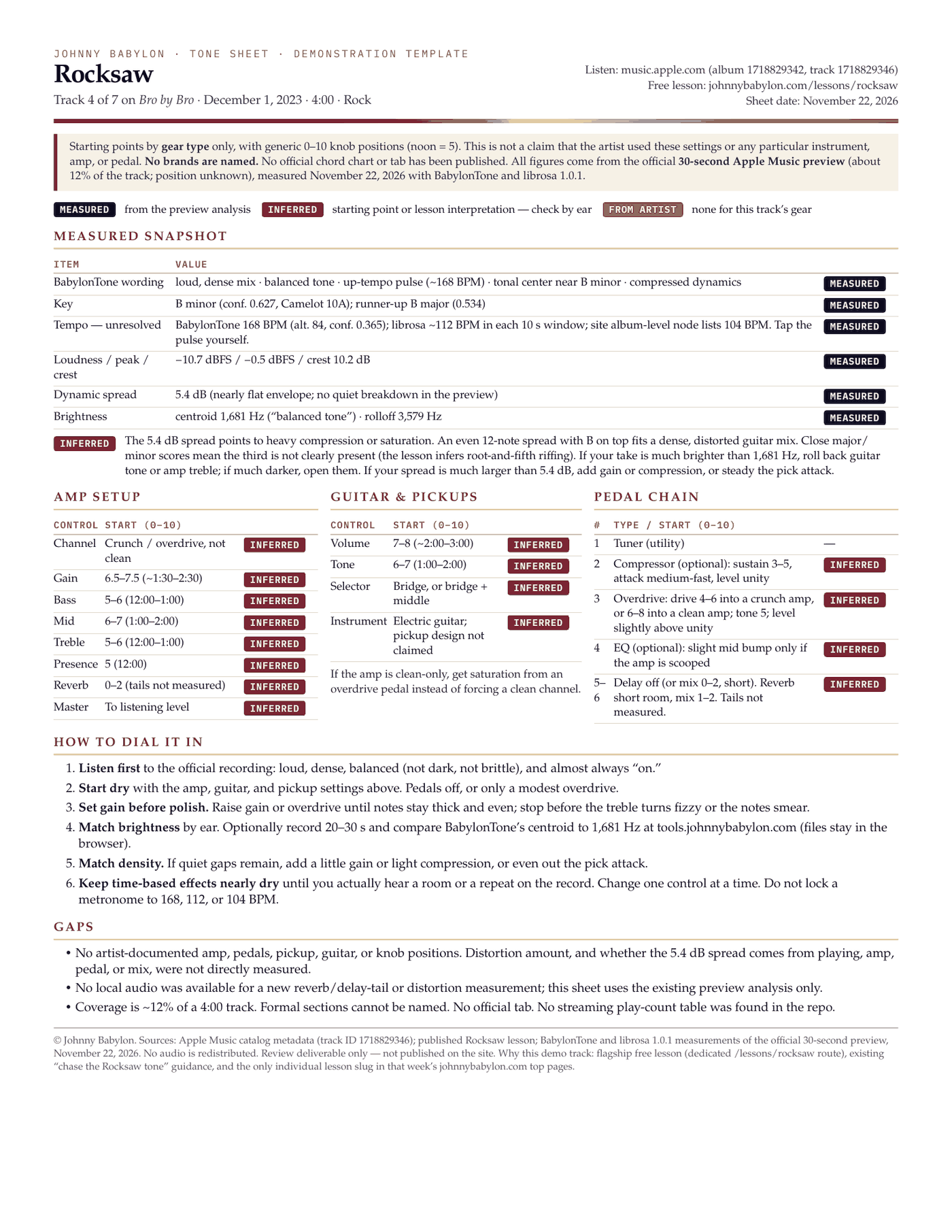
Ces réglages sont des points de départ par type de matériel, avec des positions génériques de 0 à 10 (midi vaut 5). Cela n'affirme pas que l'artiste ait utilisé ces réglages ni un instrument, un ampli ou une pédale en particulier. Aucune grille ni tablature officielle n'a été publiée. Les chiffres viennent de l'extrait officiel de 30 secondes (environ 12 % du morceau ; sa position dans le morceau est inconnue).
Les détails des réglages de cette fiche de son sont en anglais jusqu'à ce qu'une traduction native soit prête.
- MesuréIssu de l'analyse de l'extrait
- DéduitUn point de départ ou une interprétation pédagogique — à vérifier à l'oreille
- De l'artisteAucun pour le matériel de ce morceau
Télécharger le PDF d'une pageRetour à la leçon Rocksaw
Instantané mesuré
| Élément | Valeur | Libellé |
|---|---|---|
| BabylonTone wording | loud, dense mix · balanced tone · up-tempo pulse (~168 BPM) · tonal center near B minor · compressed dynamics | Mesuré |
| Key | B minor (conf. 0.627, Camelot 10A); runner-up B major (0.534) | Mesuré |
| Tempo — unresolved | BabylonTone 168 BPM (alt. 84, conf. 0.365); librosa ~112 BPM in each 10 s window; site album-level node lists 104 BPM. Tap the pulse yourself. | Mesuré |
| Loudness / peak / crest | −10.7 dBFS / −0.5 dBFS / crest 10.2 dB | Mesuré |
| Dynamic spread | 5.4 dB (nearly flat envelope; no quiet breakdown in the preview) | Mesuré |
| Brightness | centroid 1,681 Hz (“balanced tone”) · rolloff 3,579 Hz | Mesuré |
Déduit The 5.4 dB spread points to heavy compression or saturation. An even 12-note spread with B on top fits a dense, distorted guitar mix. Close major/minor scores mean the third is not clearly present (the lesson infers root-and-fifth riffing). If your take is much brighter than 1,681 Hz, roll back guitar tone or amp treble; if much darker, open them. If your spread is much larger than 5.4 dB, add gain or compression, or steady the pick attack.
Réglage de l'ampli
| Contrôle | Point de départ (0–10) | Libellé |
|---|---|---|
| Channel | Crunch / overdrive, not clean | Déduit |
| Gain | 6.5–7.5 (~1:30–2:30) | Déduit |
| Bass | 5–6 (12:00–1:00) | Déduit |
| Mid | 6–7 (1:00–2:00) | Déduit |
| Treble | 5–6 (12:00–1:00) | Déduit |
| Presence | 5 (12:00) | Déduit |
| Reverb | 0–2 (tails not measured) | Déduit |
| Master | To listening level | Déduit |
Guitare et micros
| Contrôle | Point de départ (0–10) | Libellé |
|---|---|---|
| Volume | 7–8 (~2:00–3:00) | Déduit |
| Tone | 6–7 (1:00–2:00) | Déduit |
| Selector | Bridge, or bridge + middle | Déduit |
| Instrument | Electric guitar; pickup design not claimed | Déduit |
If the amp is clean-only, get saturation from an overdrive pedal instead of forcing a clean channel.
Chaîne de pédales
| Ordre | Type et point de départ (0–10) | Libellé |
|---|---|---|
| 1 | Tuner (utility) | — |
| 2 | Compressor (optional): sustain 3–5, attack medium-fast, level unity | Déduit |
| 3 | Overdrive: drive 4–6 into a crunch amp, or 6–8 into a clean amp; tone 5; level slightly above unity | Déduit |
| 4 | EQ (optional): slight mid bump only if the amp is scooped | Déduit |
| 5–6 | Delay off (or mix 0–2, short). Reverb short room, mix 1–2. Tails not measured. | Déduit |
Comment le régler
- Listen first to the official recording: loud, dense, balanced (not dark, not brittle), and almost always “on.”
- Start dry with the amp, guitar, and pickup settings above. Pedals off, or only a modest overdrive.
- Set gain before polish. Raise gain or overdrive until notes stay thick and even; stop before the treble turns fizzy or the notes smear.
- Match brightness by ear. Optionally record 20–30 s and compare BabylonTone’s centroid to 1,681 Hz at tools.johnnybabylon.com (files stay in the browser).
- Match density. If quiet gaps remain, add a little gain or light compression, or even out the pick attack.
- Keep time-based effects nearly dry until you actually hear a room or a repeat on the record. Change one control at a time. Do not lock a metronome to 168, 112, or 104 BPM.
Lacunes
- No artist-documented amp, pedals, pickup, guitar, or knob positions. Distortion amount, and whether the 5.4 dB spread comes from playing, amp, pedal, or mix, were not directly measured.
- No local audio was available for a new reverb/delay-tail or distortion measurement; this sheet uses the existing preview analysis only.
- Coverage is about 12% of a 4:00 track. Formal sections cannot be named. No official tab. No streaming play-count table was found in the repo.